Gehrke's Gink World's Best Dry Fly Dressing Review (2026)
Updated September 20, 2026 · Research-based review
Our verdict
A classic gel floatant in a small 1/2 ounce bottle that has been a staple in fly vests for decades. It works well on most dry fly materials when applied sparingly, but it is not the right tool for CDC feathers, which need a powder floatant instead of a gel.
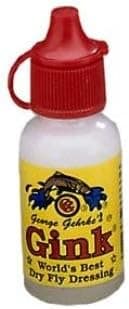
Gehrke's Gink dry fly dressing, a classic floatant gel used by fly anglers for decades.
Price range: $ (Budget)
What we liked
- + Classic gel keeps dry flies floating longer
- + Small bottle clips onto vests easily
- + Affordable and widely available
Trade-offs
- - Overapplication can weigh down delicate flies
- - Not suited to CDC feathers, which need powder floatant
What Gink Is
Gehrke's Gink is one of the oldest and most widely used dry fly floatants on the market, sold in a compact half-ounce bottle sized to clip onto a vest or slide into a chest pack pocket without taking up much room. It is a liquid emulsifier that permeates into the fur, feather, or synthetic material a fly is tied from, rather than simply sitting on the surface, which is part of why it has remained popular even as newer floatant formulas have come to market. The name has become close to a generic term among fly anglers, similar to how some brand names become shorthand for an entire category of product.
How It Performs
Gink is formulated as a light paste that turns to a thin liquid at skin temperature, which makes it easy to work into a fly between your fingers before casting. Once the fly hits cold water, the product returns to a clear, effectively invisible gel that does not add color or bulk to the pattern. It also has a specific gravity of about seventy-seven percent that of water, meaning it is lighter than water, a detail that helps explain why a properly treated fly rides up rather than getting weighed down by the floatant itself when applied in a reasonable amount.
Application and Overuse
Because Gink is a gel rather than a powder, a little goes a long way, and applying too much is a common mistake that can actually work against you. Overapplying gel floatant on a delicate pattern, especially something with fine hackle or sparse dubbing, can mat the materials down and add just enough weight to make the fly sit lower or sink faster than an untreated fly would. Most experienced anglers apply a small amount, work it thoroughly into the fly with their fingers, and let any excess dry before casting rather than coating the fly heavily right before it hits the water. A light touch generally keeps a treated fly floating high through several casts before it needs attention again.
Where It Falls Short
Gink is not well suited to CDC, or cul de canard, feathers, which rely on their natural fibers trapping air to float rather than resisting water the way a treated hackle does. Applying a liquid or gel floatant to CDC tends to mat the fine fibers together and can actually reduce the feather's natural buoyancy instead of helping it, which is why most fly anglers reach for a powder floatant like Frog's Fanny or a shake-style desiccant on CDC-heavy patterns and save gel floatants like Gink for standard hackle, deer hair, and synthetic dry fly materials.
Who Should Buy It
This is a sensible, affordable pick for anglers who fish standard dry fly patterns tied with conventional hackle, deer hair, or synthetic wings and want a proven, long-lasting floatant that has stood up over decades of use in fly vests and packs. It is inexpensive and widely stocked at fly shops and online retailers, so replacing an empty bottle is rarely a problem no matter where you fish. Anglers who fish a lot of CDC patterns will want to pair this with, or substitute it for, a powder floatant for those specific flies, since Gink alone is not the ideal treatment for that particular material.
Frequently asked questions
What size bottle does Gehrke's Gink come in?
It comes in a compact half-ounce bottle designed to clip onto a vest or fit easily in a pack pocket.
Can Gink be used on CDC flies?
It is not well suited to CDC feathers, since the gel can mat the fine fibers and reduce their natural floatation. A powder floatant works better on CDC.
How much Gink should I apply to a fly?
A small amount worked in with your fingers is enough. Overapplying can weigh a delicate fly down and cause it to float lower or sink.
Does Gink discolor or add bulk to flies?
No, once the fly hits cold water the product turns into a clear, essentially invisible gel that does not add color to the pattern.
Prices change often, so check the current price and availability on Amazon.
Check price on AmazonFly Fish Nest may earn a commission from the link above.